Private Company vs. Not-for-Profit Financial Strategy: What Leaders Need to Know
Why this matters
If you’re leading a nonprofit or charity, it’s easy to feel like you’re being measured against the wrong financial standards.
Most financial advice is built for private companies—focused on profit, margins, and growth. But nonprofits operate differently. Your goal isn’t profit. It’s impact, sustainability, and stewardship.
That difference changes everything—from how you budget to how you report to your board.
To make this clearer, we’ve created a simple side-by-side framework you can use in leadership and board conversations:
👉 Use this as a reference in your next board meeting or planning session.
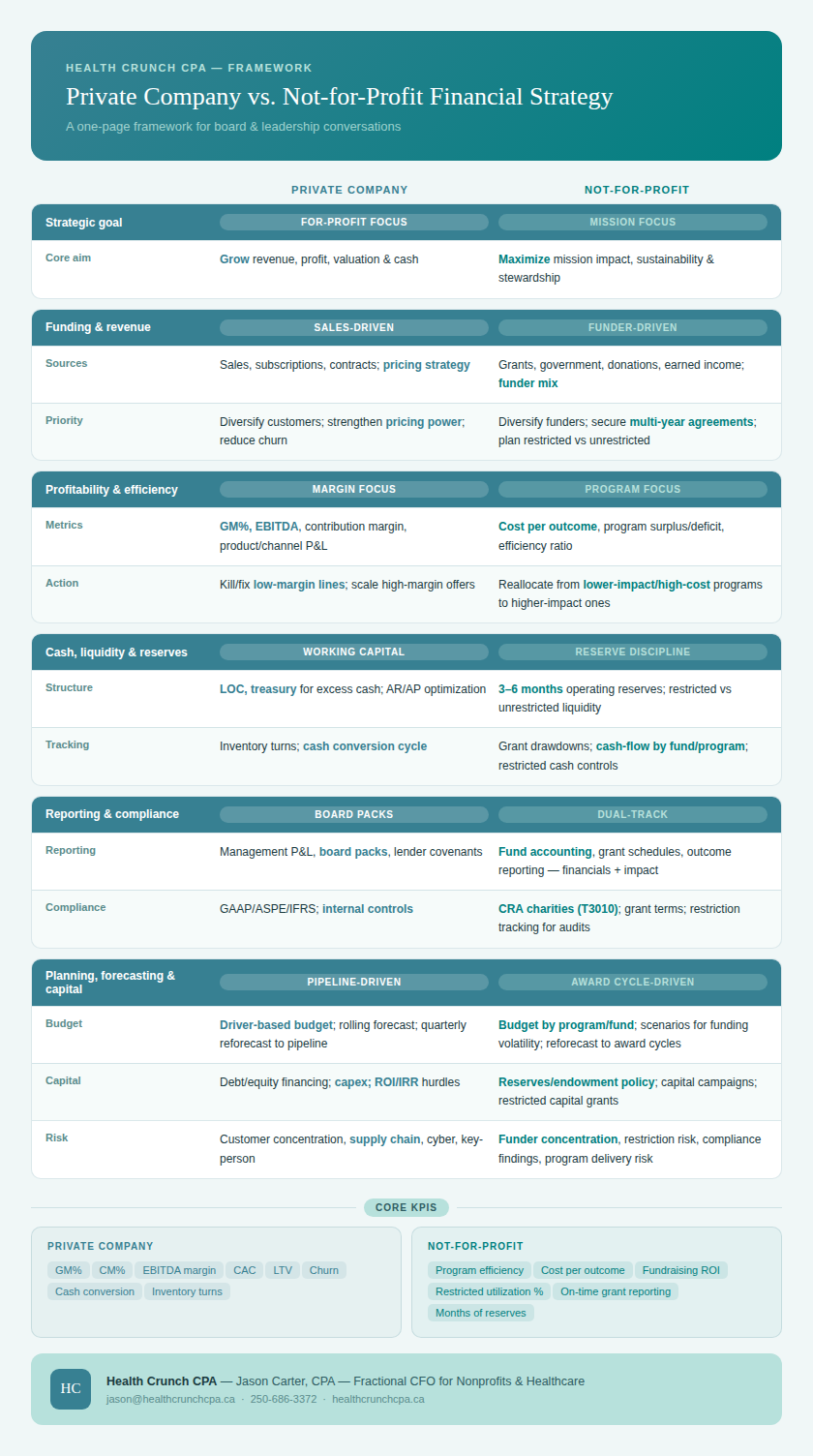
Prefer a downloadable version? Access the full framework HERE
The core shift: from profit to purpose
At a high level:
Private companies focus on revenue, profit, and valuation
Nonprofits focus on mission impact, sustainability, and stewardship
That shift shows up in five key areas.
1. Revenue strategy: sales vs. funding mix
Private companies grow through:
Sales, subscriptions, pricing strategy
Customer acquisition and retention
Nonprofits grow through:
Grants, donations, government funding, and earned income
Managing a funder mix (not just revenue growth)
What this means in practice:
You’re not just “growing revenue”—you’re balancing restricted vs. unrestricted funding
Multi-year funding matters more than short-term wins
Stability often matters more than speed
2. Performance metrics: margin vs. impact
In a business, success looks like:
Gross margin
EBITDA
Profitability by product or channel
In a nonprofit, success looks like:
Cost per outcome (what it costs to deliver impact)
Program surplus/deficit
Program efficiency ratio
Simple definition:
Cost per outcome = total program cost ÷ measurable impact delivered
Leadership takeaway:
You’re not asking “Is this profitable?”
You’re asking, “Is this the best use of our resources for impact?”
3. Cash strategy: working capital vs. reserves
Private companies manage:
Accounts receivable/payable
Lines of credit
Cash conversion cycles
Nonprofits need:
3–6 months of operating reserves
Clear visibility on grant timing
Separation of restricted vs. unrestricted cash
Common challenge:
You can have cash in the bank, but not be able to use it.
What to focus on:
Cash flow by program or fund
Grant drawdown timing
Reserve policy (targets + triggers)
4. Reporting: single track vs. dual track
Private companies report:
Profit & Loss (P&L)
Financial KPIs
Board/lender reports
Nonprofits need dual-track reporting:
Financial performance
Mission impact
That includes:
Fund accounting (tracking by restriction or program)
Grant reporting schedules
Board-friendly summaries in plain language
CRA compliance (including T3010 for registered charities, where applicable)
Leadership takeaway:
If your board can’t clearly see both financial health and impact, decision-making slows down.
5. Planning: pipeline vs. funding cycles
Private companies plan around:
Sales pipelines
Growth targets
Market expansion
Nonprofits plan around:
Grant cycles and renewals
Funding volatility
Program delivery capacity
Best practice:
Build a driver-based budget (based on real operational drivers)
Run scenarios (best case / expected / funding gap)
Reforecast quarterly based on funding changes
Where most organizations get stuck
From our experience, the biggest challenges aren’t technical—they’re structural:
Financial reports don’t reflect programs or funding reality
Cash flow is unclear (especially across restricted funds)
Boards get too much detail—or not enough clarity
Finance is treated as compliance, not strategy
This leads to reactive decisions instead of confident ones.
A practical next step
If you’re leading a nonprofit or health organization, here’s a simple starting point:
Ask yourself (or your team):
Do we clearly track restricted vs. unrestricted funds?
Can we explain our cost per outcome?
Do we have 3–6 months of reserves (or a plan to get there)?
Are our reports board-ready and easy to understand?
Do we reforecast when funding changes?
If even one of these is unclear, there’s an opportunity to strengthen your financial foundation.
Final thought
Strong financial strategy isn’t about complexity—it’s about clarity.
When your numbers are clear:
Your board makes faster decisions
Your team operates with confidence
Your organization becomes more sustainable
And ultimately, that leads to greater impact.
Want the tools behind this?
If you’d like a board-ready version of this framework + a simple reporting template, we can share what we use with clients.